
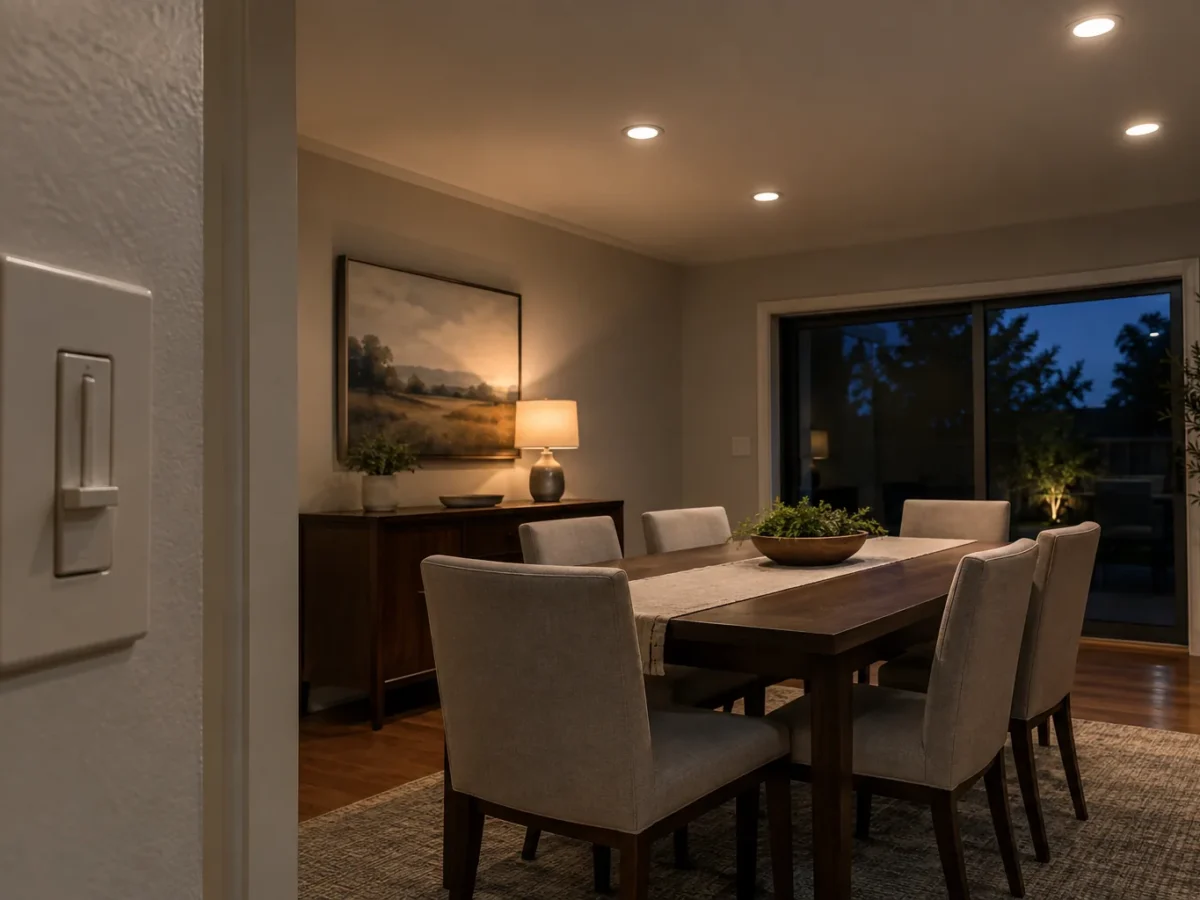
An LED fixture marked “dimmable” does not promise perfect operation with every wall control. A pot-light group may flicker at the low end, snap on suddenly instead of rising smoothly, refuse to turn fully off or hum at particular levels. Those are observable symptoms. They do not, by themselves, confirm a bad dimmer or prove the fixture is defective. The actual LED driver, number of units, control type, circuit conditions and switching arrangement all matter.
The problem often begins after a retrofit: old halogen lamps worked quietly on a control for years, then new LED products behave differently. In a Milton kitchen or living area, that can leave residents using only the full-on setting and losing the evening flexibility they expected. A useful assessment identifies all parts of the installed system and checks the problem across its operating range before recommending another device.
Common behaviours to describe
Flicker can appear as rapid flutter at one setting, an occasional flash when another load changes or pulsing across a full group. Buzz may come from the dimmer, fixture or driver. A light may “pop on” at a higher setting and then dim normally below it, or turn off abruptly before the slider reaches its end. Some LEDs glow faintly after the switch is off, and some start with a delay. Record whether one fixture behaves differently or all connected lights act alike.
There is also the reverse complaint: the lights dim smoothly, but not low enough for television viewing or a bedroom. The desired low level depends on the room and product. A controller may offer adjustable low-end trim within its instructions, yet a setting change cannot create an operating range that the LED driver does not support. Pot-light glare explores why better optical control can complement dimming.
If the symptom includes heat, burning smell, visible damage, crackling or repeated power loss, stop using the affected lighting and seek prompt qualified help. Do not remove the switch cover or test conductors. An electrical fault can coexist with a product compatibility issue and cannot be excluded by the fact that a problem appears only while dimming.
The fixture, driver and control form one system
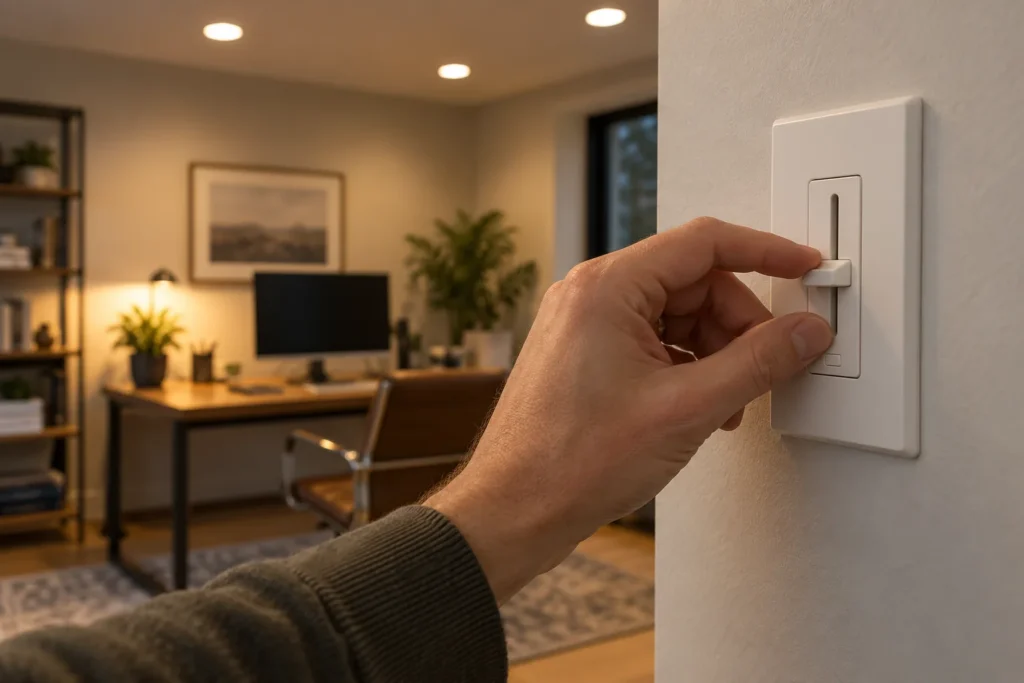
The LED light source needs an electronic driver, integrated with or separate from the fixture. Dimmers manipulate power in a way that the driver must support. Product specifications may identify compatible control technologies and tested models, but a package that merely says “dimmable” often leaves important details unknown. The number of fixtures and their total load must also be within the selected control’s supported range. Very low aggregate LED loads can behave differently from the much higher incandescent load the old control was designed for.
Mixing different fixture models on one dimmer complicates performance. One group may have several integrated LED pot lights, a pendant using replaceable LED lamps and a cabinet strip on its own driver. These products may dim at different rates or have incompatible requirements. Separate zones may be more useful than trying to force all layers onto a single control. In a kitchen, pot lights, island pendants and under-cabinet light often support different tasks and scenes; kitchen lighting layers covers that plan.
Multi-location switching adds another question. A wall control paired with one or more companion switches needs the arrangement specified by its manufacturer. Smart controls may also require particular wiring, a neutral conductor, compatible bulbs or a hub and may behave differently when connectivity is lost. A product’s ability to fit a wall box does not establish that it suits the existing installation. Smart lighting and dimmer installation address controls as separate services.
A sensible compatibility review
Start with model information: the current dimmer, the exact fixture or lamp, any separate driver and the number of units in the zone. Share packaging or product links if you still have them. Note the dimmer setting at which the problem begins and whether it happens after a cold start, with lights warm or only when another normal load operates. A short safe video can document intermittent behaviour. It cannot substitute for inspection of the installation.
A qualified person can review product documentation and installed conditions, distinguish compatibility from a failed component and test operation. Possible outcomes include an appropriate compatible control, a correctly matched LED product, a change to zoning or repair of a separate electrical issue. The right answer depends on the actual installation. Randomly purchasing a universal-sounding dimmer, or trying multiple LED products until one seems to work, can waste time and create a mismatched ceiling.
For older recessed housings, an LED retrofit must be evaluated against the housing and any product instructions. Not every attractive LED module is approved for every existing housing, and not every old can must be removed for a conversion. Old recessed lighting describes that choice. If an individual slim fixture has failed, a substitute also needs physical, optical and control compatibility with its neighbours.
Plan for the room, not just a slider
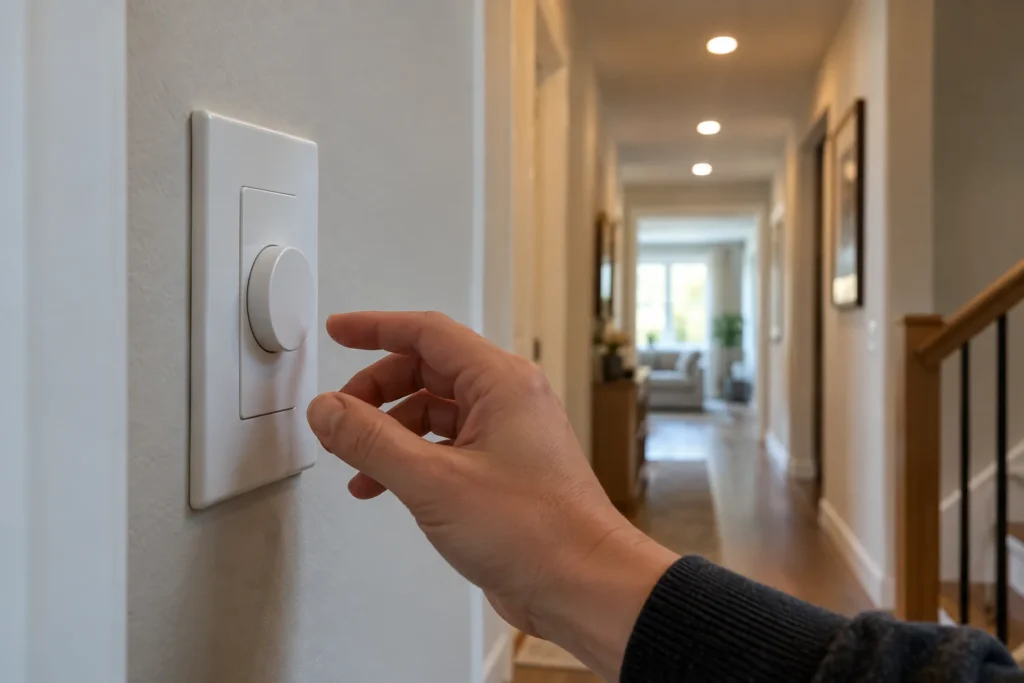
The goal is useful light at the levels people actually use. A family room may need gentle perimeter lighting during a film, enough light for cleaning and perhaps a separate reading lamp. A bedroom should avoid harsh downlight into the bed while permitting bright wardrobe use. An office may need stable light for video calls without screen glare. Compatible dimming is valuable, but a poorly located or overpowering fixture can remain uncomfortable throughout its range.
Ask what a proposed control will operate, whether the fixture group has a documented smooth range, how multi-location operation will work and whether manual operation remains intuitive. Test the finished installation at full output, intermediate levels, the practical minimum and off. Listen for noise and check for flicker across all units. An estimate should specify both control and fixture models where product compatibility is central to the work.
Ontario requirements and product approval
Ontario’s Electrical Safety Authority says that a business hired to do electrical work in a home must be a Licensed Electrical Contractor. The person doing notifiable electrical work files the Notification of Work before starting. ESA says almost all electrical work requires notification, with narrow exceptions tied to precise replacement conditions; the fact that a dimmer is a small device does not establish an exemption for any wider recessed-lighting job. After review and passing, ESA issues a Certificate of Acceptance. See electrical requirements for the process.
ESA also requires electrical products used in Ontario to have approval by an accredited agency, shown through a recognized mark or label. This applies to the selected equipment; words such as “professional grade” in a listing are not an approval mark. A component-recognition marking can have limits when the part is used on its own. Approved products explains the difference at a homeowner level.
Questions homeowners ask
Why did the old halogen lights dim but my LEDs flicker?
The two loads behave differently, and an older control may not be compatible with the LED drivers. That is a common hypothesis, not a confirmed diagnosis. Check models, connected load and the condition of the circuit before deciding which part to change.
Will any LED-rated dimmer work with my pot lights?
No. LED-rated controls cover different technologies and load ranges. Manufacturer compatibility information for the exact products and the actual switching arrangement is more useful than a broad marketing label. Mixed fixtures on one control deserve extra review.
Is slight glow when off a wiring fault?
It can have several causes, including control/product interaction, and must not be diagnosed remotely. Note which fixtures glow and what control is present. Seek qualified assessment, especially if there are other unusual symptoms or safety concerns.
Share the products and the symptom
Use contact to send the fixture and control models if known, the number of lights, whether there are multiple switch locations and a description of the problematic range. Compare flickering pot lights and buzzing lights or dimmers if those are the dominant symptoms. A focused lighting repair review can distinguish controls, products and electrical conditions before parts are purchased.