
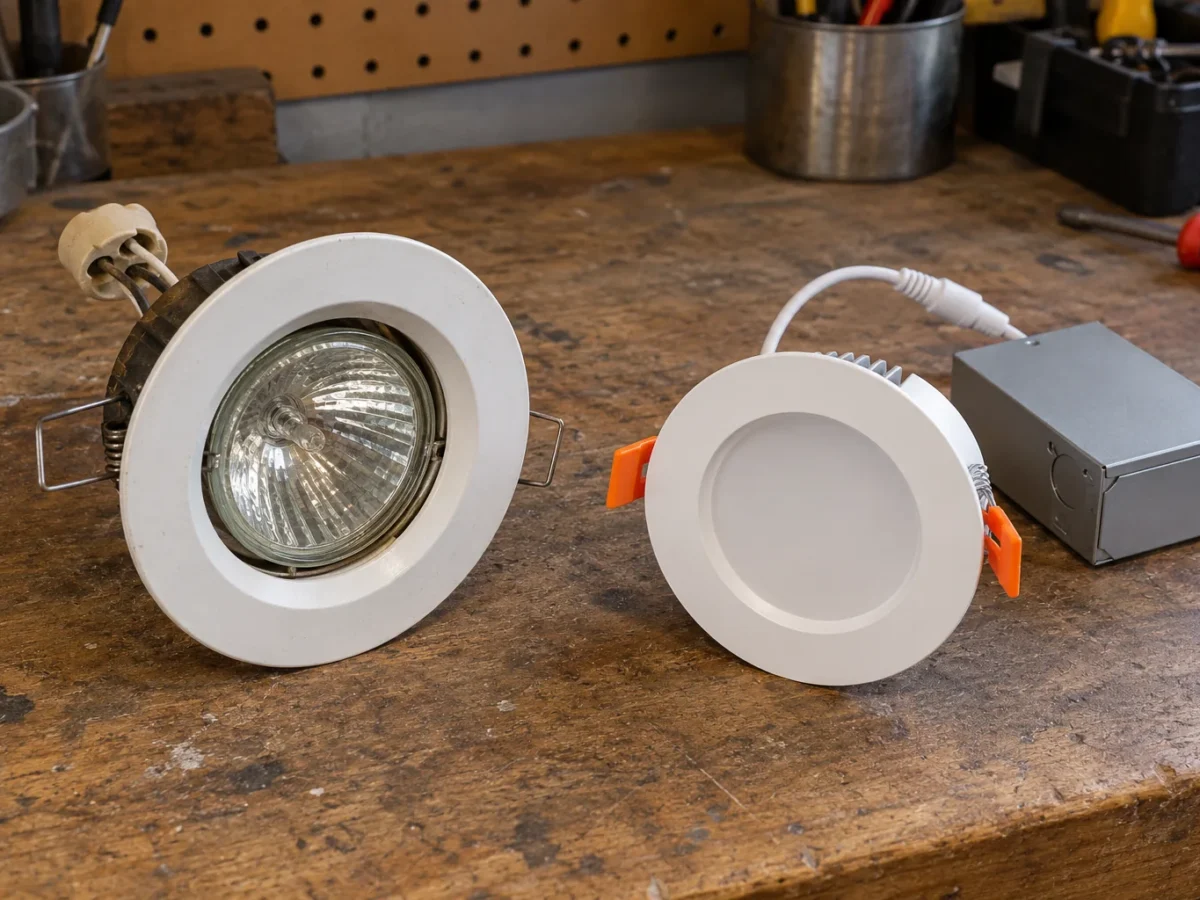
An LED pot light can look convincing online and still be inappropriate for an Ontario installation. Approval and application suitability are separate checks: the electrical product needs a recognized approval mark or label, and the chosen model must be used in the location and assembly covered by its instructions. A pleasing colour temperature or a claimed long life does not satisfy either requirement. This guide explains the questions a Milton homeowner can ask a supplier and the electrical contractor before buying a fixture.
Start with Ontario's recognized marks
The Electrical Safety Authority says an electrical product used, sold, displayed or advertised for sale in Ontario must be approved by an accredited certification or evaluation agency and carry that agency’s official mark or label. ESA maintains the current list of recognized certification and field evaluation marks. Consult that list rather than relying on a social-media seller’s “certified” claim. Marks such as CSA and certain cUL or cETL markings may appear, but the exact accepted marking and scope matter; look at ESA’s current list of markings.
The mark needs to relate to the actual product being installed. A generic product-page image can show a different regional variant. Inspect the delivered packaging and label, note the exact model number and compare it with documentation. Some component-recognition marks apply only to components intended for use within an approved larger system; they do not automatically approve an assembly improvised from separate parts. ESA’s page explicitly cautions about those restrictions. A seller’s CE symbol alone should not be mistaken for a recognized Canadian approval mark.
Understand the complete fixture system
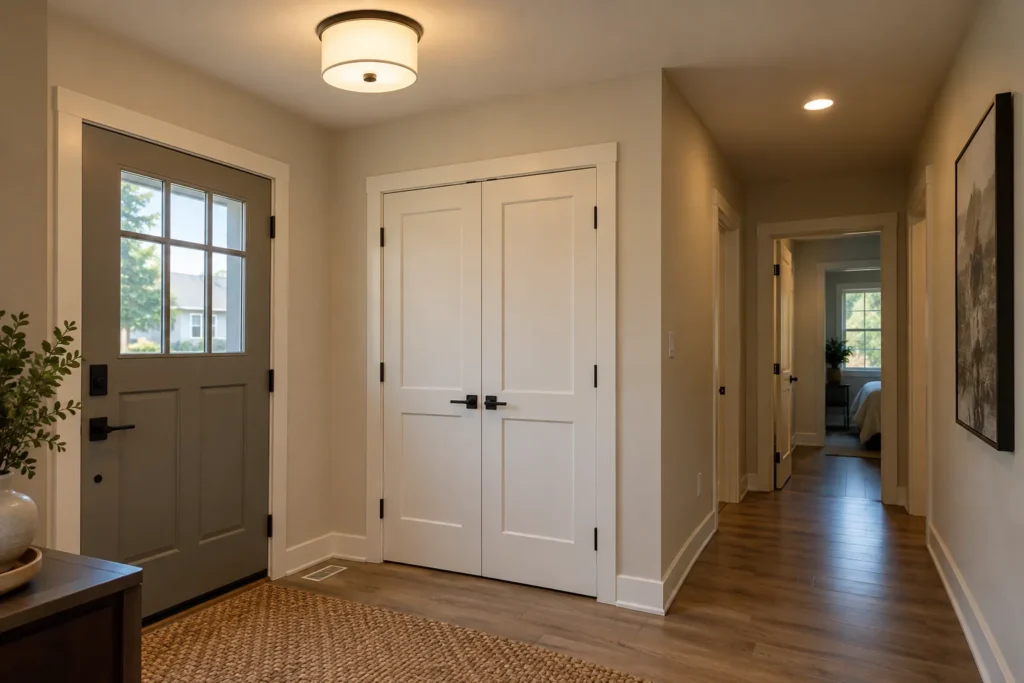
Many integrated LED products include a light module, driver or power supply, junction component, connectors and trim. Verify which parts form the approved product or approved combinations. A loose driver with a recognizable mark does not by itself establish that an arbitrary light module and connector set can be combined safely. Conversely, a complete listed product should be installed according to its included instructions and with the specified components. Ask for the cut sheet that identifies the exact combination proposed in the estimate.
Check whether the fixture uses a replaceable lamp, a retrofit module for a specified housing or a complete new assembly. These are different product paths. An approved retrofit can be sensible where an existing housing is suitable, but it must be compatible with that housing. Altering a luminaire outside its approved configuration can undermine the approval. ESA’s product safety information is a starting point; the installer should assess the complete installed arrangement.
Match the product to the location
A dry interior hallway, a bathroom, a shower area and an exterior soffit present different environmental exposures. Look for the manufacturer’s specified suitability for dry, damp or wet use as appropriate to the actual position. The label “outdoor” in a marketplace title is not a precise substitute. Exposure to wind-driven rain, condensation, spray or winter conditions should be discussed in the soffit layout and installation plan. If the setting is uncertain, the qualified installer should determine what product rating is required rather than guess.
Product suitability also includes ceiling material, insulation contact where relevant, required clearances, temperature limits and access to the driver. An attic with insulation is not equivalent to an uninsulated interior cavity. A shallow-looking fixture is not automatically approved to touch insulation. Follow the exact model’s instructions. Our slim versus traditional guide explains how product form affects these choices without implying that any type fits everywhere.
Compare the lighting performance separately
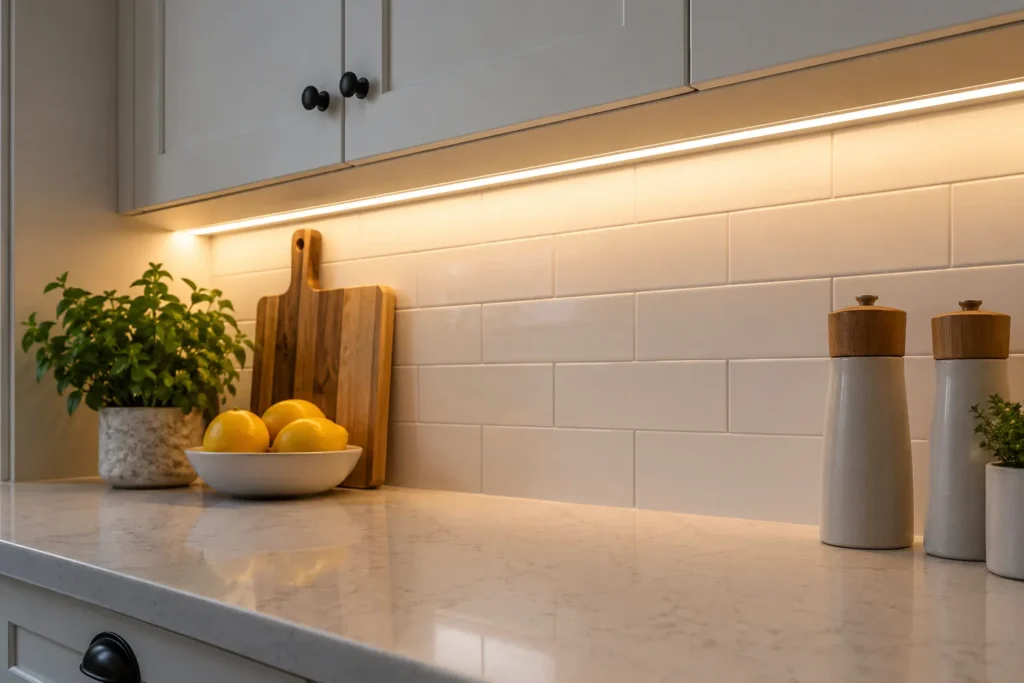
Approval means a product met an applicable safety evaluation; it does not guarantee the design will look good in your room. Compare rated output, beam angle, glare control, colour temperature, colour rendering, trim and dimming characteristics. A bright broad diffuser might suit a utility space but be uncomfortable over a sofa. A narrow beam can emphasize a wall but leave counter work uneven. Use the quantity guide and spacing guide to select performance for the surfaces that matter.
Be cautious with ambiguous marketing terms such as “super bright.” Ask for an identifiable lumen rating and photometric data when available. Make sure the colour selected on a tunable fixture is recorded and consistent across visible rows. For a connected kitchen and living area, compare candidate products on the actual finishes after dark. A low purchase price loses value if colour consistency or dimming is poor and the whole row has to be changed.
Dimming and controls need a product match
“Dimmable” is not the same as compatible with every existing wall control. LED drivers and dimmers have different operating ranges, minimum and maximum loads, neutral requirements and multi-way arrangements. A mismatch can produce flicker, buzzing, limited low-end range or unwanted shutoff. Request a manufacturer compatibility list for the exact fixture and control where one exists. The electrical professional should assess the existing wiring and specify an appropriate arrangement. Our LED dimmer compatibility guide offers the non-DIY planning questions.
Smart products add another system layer: wireless controls, compatible hubs or switches and behaviour after a power interruption can all matter. A smart bulb in a fixture controlled by a conventional dimmer may require a different control strategy from an integrated smart luminaire. Do not combine products merely because their packaging uses similar words. Document the model numbers and expected control behaviour in the quotation.
Verify the purchase before the ceiling is cut
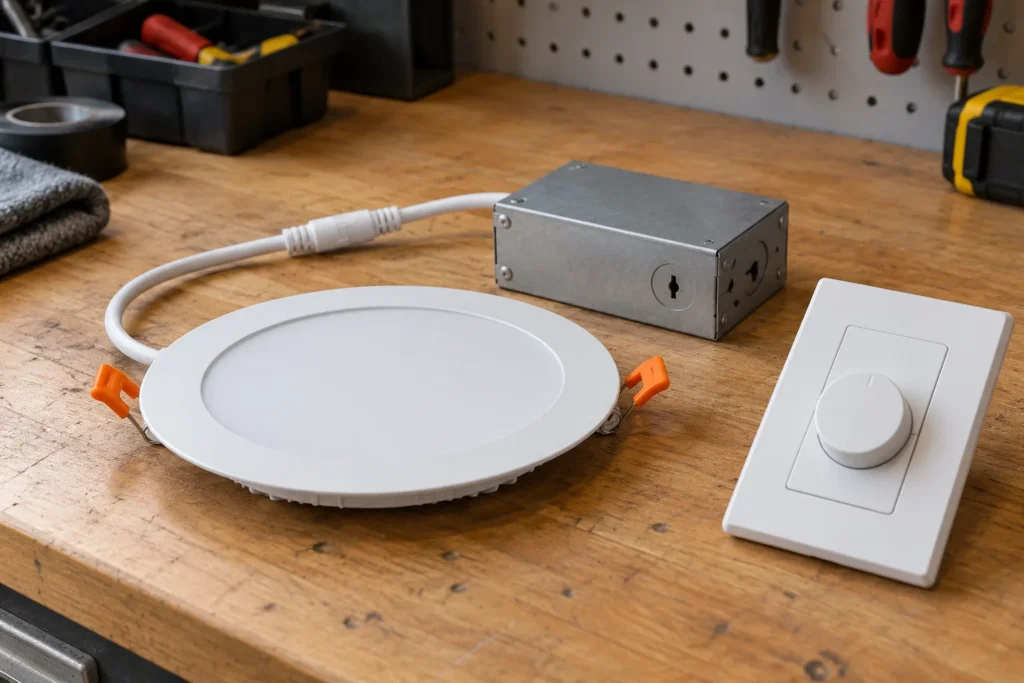
Ask for model numbers and cutout dimensions before any openings. Confirm the intended trim colour, colour temperature, beam, driver location and whether the fixture is appropriate for the specific ceiling and location. If a supplier substitutes another product, revisit approval, size, optics and dimmer compatibility. A seemingly equivalent fixture might need a different hole or produce a different pattern of light. The 4-inch versus 6-inch guide explains why nominal diameter is not enough.
Keep invoices and packaging or digital specification sheets. Future service or replacement is easier when the exact product family is known. Ask about manufacturer replacement availability and review written warranty terms from the actual seller and product documentation. A well-documented selection protects the appearance of connected rooms if one unit later changes.
Pay attention to the seller and documentation
If a listing bundles several colour, wattage or market variants, ask the seller to identify the exact approved Canadian model being shipped. Keep photographs of its label and the installation instructions once it arrives. If the specified product is unavailable, insist that any substitute is reviewed for approval, opening size, output, beam, colour and control compatibility before installation. A last-minute substitution can leave one light visually different from the rest of a row or make an existing dimmer unsuitable. Good documentation is part of a durable lighting plan, not just paperwork for a product return.
Product approval and electrical review are distinct
An approved fixture is necessary, but it does not approve the electrical installation or remove the need for the applicable ESA notification. ESA says almost all electrical work requires a Notification of Work. When a Licensed Electrical Contractor is hired, that contractor files it. ESA’s notifications and inspections page provides current guidance; our ESA guide explains the homeowner questions. The two checks serve different purposes: one concerns the product, the other the work in the building.
Is an online “certified” badge enough?
No. Verify the actual recognized Canadian approval mark or label on the product and its exact model. Compare it against ESA’s current list and ask for documentation if the marking is unclear.
Does a driver with a mark approve the whole kit?
Not necessarily. Component marks can have restrictions. The installed fixture, driver and connector arrangement must match the approved product or listed system and the manufacturer’s instructions.
Can an indoor LED be used in a protected soffit?
Do not assume so. The location may still be damp or otherwise exposed. Select a product suitable for the assessed conditions. For a room or exterior plan, request an estimate with your chosen product information.